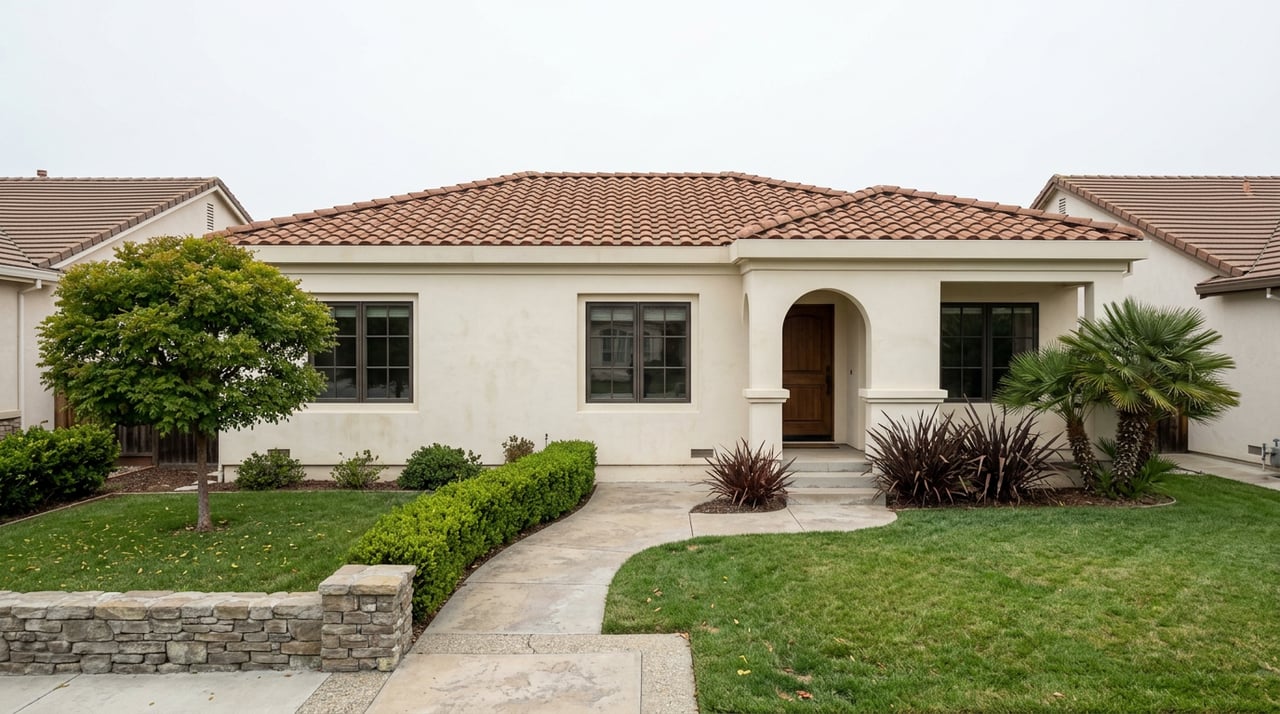
An Ontario Home's Airport Easement Isn't About the Noise You Hear Today
September 24, 2026
September 24, 2026
A buyer under contract on a home near the 60 Freeway in Ontario gets to the title report and finds a line item labeled "avigation easement." Most buyers skim past it. It reads like boilerplate, the kind of legal language every property seems to carry somewhere in its history. The agent might mention it's related to the airport and move on. The buyer signs.
What that buyer didn't ask, and what almost nobody asks, is which airport's influence area applies, what rights the document actually grants away, and how its terms compare with the applicable compatibility-zone map. Those are three different questions with three different answers, and the gap between them is where the real friction sits for anyone buying or selling inside Ontario's airport-affected zones right now.
An avigation easement is a real, recorded interest in the airspace above a specific parcel. The City of Ontario's own Airport Land Use Compatibility Plan includes a sample version of this document, and it's worth understanding what it actually does. The easement grants a perpetual, assignable right to fly aircraft through the airspace above the property, and it grants the right to create noise, vibration, and other effects of flight within that same airspace. It also restricts what the property owner can build or grow above a defined elevation, described in the document as an "imaginary plane," so that trees, rooftop additions, or antennas don't become obstructions to approach and departure paths.
This isn't a temporary notice. It's recorded against the property and it runs with the land, meaning it transfers automatically to every future owner. A homeowner who never once complained about aircraft noise can still be bound by an easement their builder or a prior owner accepted decades earlier as a condition of development approval.
Here's the detail that surprises most people, including some who've lived in Ontario for years. The city sits inside two separate airport influence areas, not one.
The first is the Ontario International Airport Land Use Compatibility Plan, adopted by the Ontario City Council on April 19, 2011. It establishes an Airport Influence Area covering parts of San Bernardino, Riverside, and Los Angeles counties, and it regulates future development based on four compatibility factors: safety, noise, airspace protection, and overflight impact.
The second is newer and far less known outside city planning circles. In August 2022, Ontario's City Council adopted a separate compatibility plan for Chino Airport, establishing an overlay zoning district that applies solely within Ontario's own city limits. It regulates development for safety, airspace protection, and overflight impact, similar to those in the ONT plan, but notably does not list noise among its stated compatibility factors.
| Ontario International Airport (ONT ALUCP) | Chino Airport Overlay (CNO ALUCP) | |
|---|---|---|
| Adopted | April 19, 2011 | August 2, 2022 |
| Geographic reach | Parts of San Bernardino, Riverside, and Los Angeles counties | Solely within Ontario city limits |
| Compatibility factors | Safety, noise, airspace protection, overflight | Safety, airspace protection, overflight |
A parcel near the southern edge of the city can fall inside both influence areas at once, or inside one without the other, depending on exactly where it sits relative to each airport's mapped zones. A buyer who assumes "the airport disclosure" refers to a single document, covering a single set of flight paths, is working from an incomplete picture. The city's own Airport Land Use Compatibility Plan page lays out both plans side by side, and it's worth a look before writing an offer on anything near either airport's boundary.
This is where the timing actually matters for anyone in escrow this fall. Ontario International Airport isn't sitting still. In May 2026, the Ontario International Airport Authority launched formal environmental review for a program it calls ONT BOLD, a more than $1 billion expansion that includes a new 650,000-square-foot Terminal 3 along with modernization of the existing Terminal 2 and Terminal 4. The stated reason is capacity. Passenger volume has grown roughly 70 percent since 2016 to about 7 million travelers a year, enough to outpace what the current terminals were built to handle, according to reporting on the Terminal 3 expansion. The airport's own materials describe the buildout as a ten-year, phased project.
On the ground, some of that growth is already visible. Terminal 2's upgrades were finished on July 24, 2026, and Terminal 4's exit corridor and restroom renovations wrapped on August 17, 2026, with an additional security screening lane targeted for completion this fall, according to the airport's own construction updates.
None of this changes an easement that's already recorded. For a new-construction property inside an Airport Influence Area, a buyer can review the recorded easement and the applicable airport-zone map to understand the property's documented terms.
California law has required sellers to disclose airport proximity to buyers since January 1, 2004, typically through the standard Transfer Disclosure Statement. Once that disclosure is made, the seller and their agent generally aren't required to provide additional detail about airport-related noise or annoyance beyond it, a point confirmed in the legislative analysis behind the state's airport disclosure statute. That's a meaningful detail for a buyer to understand: the legal minimum is a notice, not a conversation. Anything beyond that notice is on the buyer to pursue.
Before writing an offer on a home inside either Airport Influence Area, it's worth requesting a few specific things rather than accepting a general assurance that "it's disclosed":
For resale homes, the easement was likely recorded years or decades ago, so buyers should review the recorded document for its terms. For new construction inside the influence area, the easement being signed this year will sit on the title for as long as the home stands; reviewing it alongside the applicable airport-zone map can clarify the property's documented restrictions.
None of this is a reason to avoid a home inside Ontario's Airport Influence Area. Plenty of well-priced, well-built homes sit inside these zones, and an overflight notification simply informs a buyer that aircraft may pass overhead. The distinction that matters is between a notification, which is informational, and an easement, which is a permanent legal interest attached to the land.
The practical move is to separate the three questions that get collapsed into one when people talk about "the airport disclosure": what does the seller legally owe you, what does the recorded document actually restrict, and how should you assess airport growth separately from the terms of the property's easement. Those are three different lines of inquiry, and a buyer who only asks the first one is leaving the other two for the seller to answer, or not.
Does an avigation easement mean I can't add a second story or build a patio cover? Not necessarily. The restriction generally applies to height relative to the elevation plane defined in the easement, meant to protect flight paths from obstruction, rather than a blanket ban on home improvements. The specific limit varies by parcel and is worth confirming before planning any addition.
If I'm buying new construction, didn't the builder already handle this? The developer typically dedicates the avigation easement as a condition of subdivision approval, and state law requires airport proximity to be noted in the subdivision's public report. That satisfies the disclosure obligation for the initial sale. It doesn't remove the requirement for a Transfer Disclosure Statement the next time that home changes hands.
Is every home in Ontario inside an Airport Influence Area? No. Only parcels within the mapped boundaries of the ONT plan or the Chino Airport overlay are affected, and those boundaries are defined by each plan's own compatibility zone maps, not by the city limits as a whole.
Buying or selling a home near either of Ontario's airport influence areas isn't complicated once you know which questions to ask and which document actually governs the answer. If you're weighing a purchase inside one of these zones, or preparing to sell a home that carries a recorded easement, Lily Valdivia can walk through exactly what's on your title and what it means for your timeline. Let's Connect.
This article is general information, not legal, tax or financial advice. Consult a qualified professional about your situation.
Stay up to date on the latest real estate trends.

Work with a REALTOR® who values your story, understands your goals, and is committed to helping you feel truly at home.